

Existence periods
Most elements in 4HSE can have existence periods: they say when — for how long, and how often — that element was part of your safety project.
When they do not apply
Section titled “When they do not apply”Some elements are intrinsically tied to a date or a fixed interval, so a period would mean nothing: the edition of a course, a medical examination, a certificate.
The typical case: seasonal work
Section titled “The typical case: seasonal work”Take an employee, Mario Rossi, who worked in two distinct periods: from 1 October to 1 December 2019, and then from 1 January 2020 on an indefinite contract.
| Start | End | |
|---|---|---|
| Period 1 | 01/10/2019 | 01/12/2019 |
| Period 2 | 01/01/2020 | +infinite |
During his employment he was assigned to a work phase, attended two courses, and received a high-visibility vest. Those elements are children of the person, who is their parent:
+ Mario Rossi |_ Warehouse management |_ Forklift operator training |_ General training |_ High-visibility vestThis parent–child structure recurs throughout 4HSE, and it is what makes inheritance work.
Why inheritance matters
Section titled “Why inheritance matters”By default an element has an infinite lifespan. But an element with no period of its own implicitly inherits the periods of its parent.
So the courses Mario attended cannot exist outside the time he was employed, without anyone having to say so. If you never set a period on them, they last exactly as long as he does.
This is what keeps the data honest: a certificate cannot silently outlive the employment it belongs to, and a worker’s history does not have to be maintained in two places.
Say his four child elements have these periods:
| Element | Start | End |
|---|---|---|
| Warehouse management | 15/10/2019 | 30/11/2019 |
| Forklift operator training | 05/10/2019 | 15/11/2019 |
| General training | inherited from Mario Rossi | inherited from Mario Rossi |
| High-visibility vest | 10/10/2019 | 30/11/2019 |
Three of them have periods of their own. General training does not, so it inherits Mario’s — and any child added later will do the same.
The rules
Section titled “The rules”| Rule | |
|---|---|
| Default | an element has an infinite lifespan, from minus infinity to plus infinity |
| Implicit inheritance | an element with no period of its own inherits its parent’s, when the parent has one |
| Containment, upwards | for every period of the current element there must be at least one parent period containing it |
| Containment, downwards | for every child period there must be at least one period of the current element containing it |
4HSE enforces these constraints as you add or edit periods, so the hierarchy stays consistent.
What the chart shows
Section titled “What the chart shows”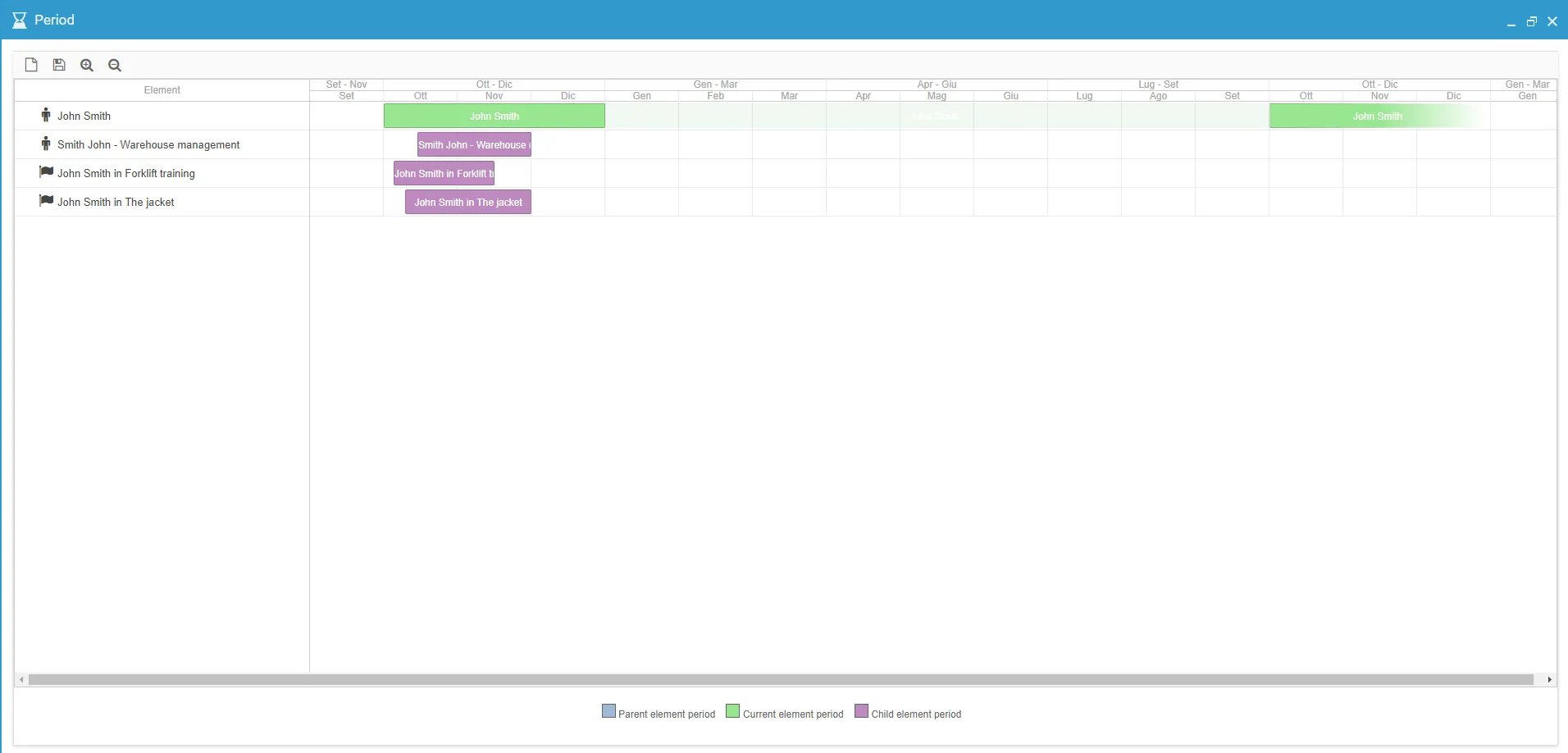
The chart shows the child periods in purple, all of them inside Period 1. An element that inherits its periods is not drawn: having no periods of its own, it has nothing to draw — which is why General training is missing from the chart above.
The parents of the person are not drawn either, because their lifespan is infinite.
Where each period is edited
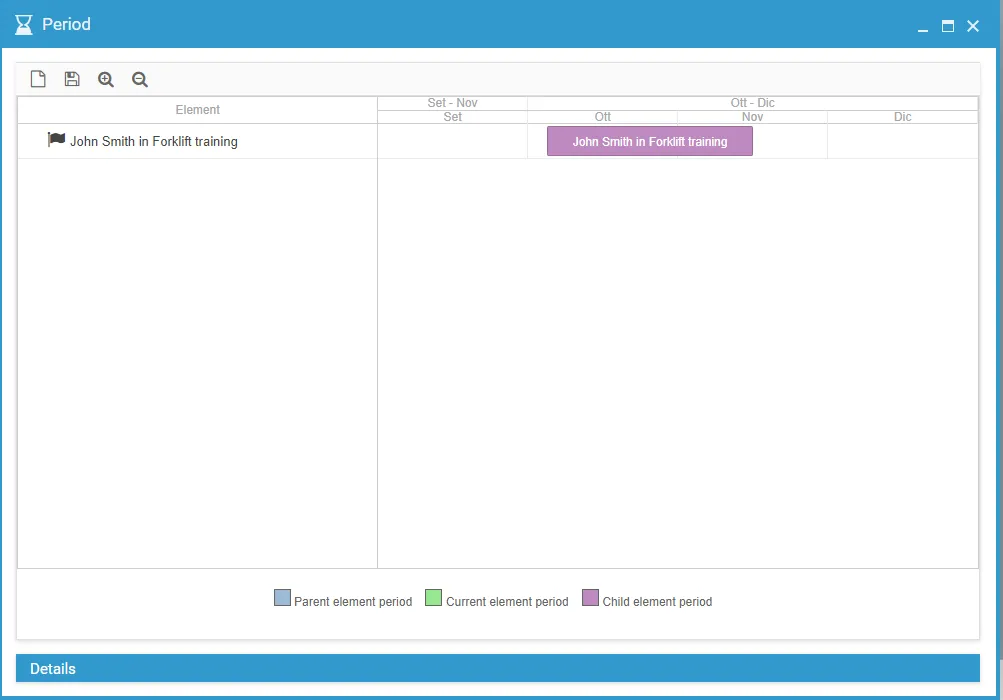
Section titled “Where each period is edited”Parent and child periods are not editable from this window: each is changed from the period window of its own element.
To change the period of Mario Rossi’s Forklift operator training, go to its detail form — Project / Office / Actions / Training / Courses / Forklift operator training / People / Mario Rossi — and click the period icon there.
This site is protected by reCAPTCHA and the Google Privacy Policy and Terms of Service apply.