

Risk assessment
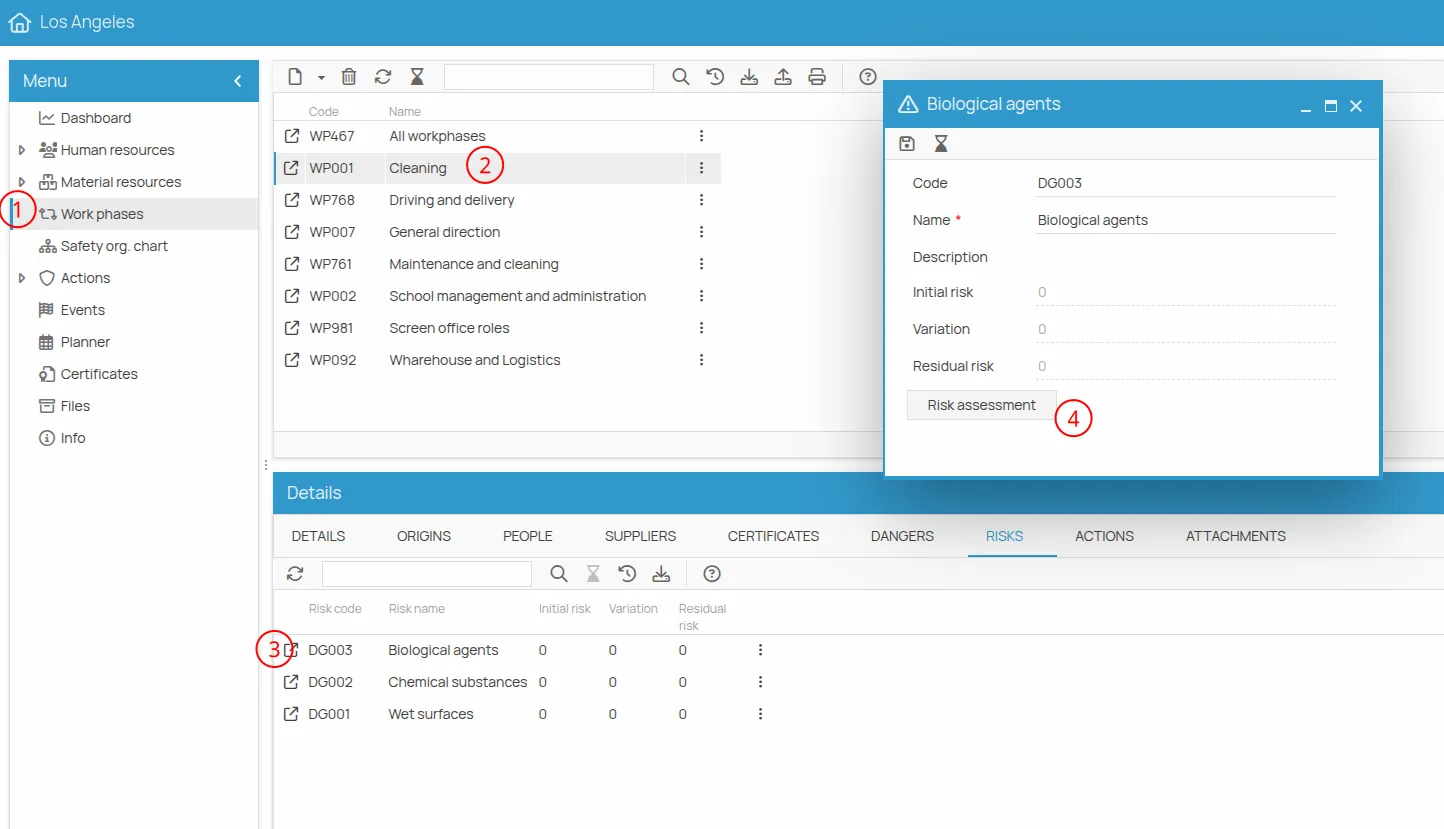
Risk assessment connects what people do to what protects them. 4HSE builds it in four steps, each of which presupposes the previous one: skipping a step makes the later ones unusable.
- Describe the work. A work phase records in detail what workers actually do.
- Find the hazards. They come from the physical resources the work uses — environments, equipment, substances.
- Identify the risks. A hazard that is present in a phase becomes a risk for the people in that phase.
- Reduce them. The prevention actions linked to the phase are the measures, and their effect is measured on the risk itself.
The aggregator: what you assess around
Section titled “The aggregator: what you assess around”Before starting, a project chooses what the assessment is organised around. It can be the work phase, the job position, or the homogeneous group — see Risk aggregators. The choice reflects how the organisation actually works, and it decides where the risk management sections appear.
The rest of this area uses the work phase, which is the most common choice.
Exposure, not just presence
Section titled “Exposure, not just presence”The same hazard does not carry the same risk for everybody. What changes is how long, how often and under what conditions a person is exposed — which is why people are linked to the phase, not to the hazard. A phase that lasts ten minutes a month and one that lasts six hours a day produce different assessments from the same starting point.
Initial risk and residual risk
Section titled “Initial risk and residual risk”The assessment is not a single number. 4HSE keeps two:
- the initial risk, before the measures;
- the residual risk, after them.
Keeping both is what makes the measures accountable: it shows what has been gained, and what remains. See Initial and residual risk.
This site is protected by reCAPTCHA and the Google Privacy Policy and Terms of Service apply.